A quarter of the world’s population across 17 countries are living in
regions of extremely high water stress, a measure of the level of
competition over water resources, a new report reveals.
Experts at the World Resources Institute (WRI)
warned that increasing water stress could lead to more “day zeroes” – a
term that gained popularity in 2018 as Cape Town in South Africa came dangerously close to running out of water.
Qatar, Israel and Lebanon were ranked as the most water stressed
countries in the world, with Badghis in Afghanistan and Gaborone and
Jwaneng in Botswana the world’s most water-stressed regions.
WRI said the data reveals a global water crisis that will require better information, planning and water management.
“Water matters,” said Betsy Otto, global director for water at WRI.
“We’re currently facing a global water crisis. Our populations and
economies are growing and demanding more water. But our supply is
threatened by climate change, water waste and pollution.”
The global research organisation compared the water available to the
amount withdrawn for homes, industries, irrigation and livestock.
In the 17 countries facing extremely high water stress, agriculture,
industry, and municipalities were found to be using up to 80% of
available surface and groundwater in an average year. When demand rivals
supply, even small dry spells, which are set to increase because of the
climate crisis, can produce dire consequences.
Twelve of the 17 high-risk countries were in the Middle East and North Africa.
The level of water stress in India, a country of more than 1.3
billion people, was striking, experts noted. India ranked 13th in the
report.
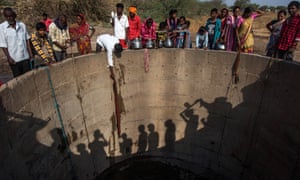
In July, taps in the southern city of Chennai ran dry and satellite photographs showing an empty lake in the city went viral on social media.
“The recent water crisis in Chennai gained global attention, but
various areas in India are experiencing chronic water stress as well,”
said Shashi Shekhar, former secretary of India’s ministry of water
resources, and senior WRI fellow.
Although the US did not have high levels of water stress overall, a
handful of states – including New Mexico and California – were found to
be facing significant strains on their water supplies that will only
intensify with global heating.
New Mexico was found to have “extremely high” pressure on water
availability. The state’s score is on par with the United Arab Emirates
and Eritrea.
In 2012, two-thirds of the US experienced drought, said Brad Rippey, a meteorologist for the Agriculture Department.
California, which experienced a drought in 2011 that did not subside
until a couple of years ago, is expected to see huge population growth,
while facing temperatures up to five degrees warmer and rising sea
levels, said Joaquin Esquivel, chair of the California Water Resources Control Board.
World Bank research has emphasised that “while the consequences of drought are often invisible, they are significant and cause ‘misery in slow motion”.
The report paints a worrying image of water risk and warns of other social and political problems attached to water shortages.
Around the world, stress on water supplies can exacerbate conflict and migration, threaten food supplies and pose risks for water-dependent industries, including mining and manufacturing, WRI notes.
“The picture is alarming in many places around the globe, but it’s
very important to note that water stress is not destiny. What we can’t
afford to do any longer is pretend that the situation will resolve
itself,” said Otto.
“With respect to climate change we know that in many places what
we’re going to be seeing is more erratic, more unpredictable hydrology,
precipitation. Either too much or too little, often in the same places.”
As the crisis escalates…
… in our natural world, we refuse to turn away from
the climate catastrophe and species extinction. For The Guardian,
reporting on the environment is a priority. We give reporting on
climate, nature and pollution the prominence it deserves, stories which
often go unreported by others in the media. At this pivotal time for our
species and our planet, we are determined to inform readers about
threats, consequences and solutions based on scientific facts, not
political prejudice or business interests.
More people are reading
and supporting The Guardian’s independent, investigative journalism
than ever before. And unlike many news organisations, we have chosen an
approach that allows us to keep our journalism accessible to all,
regardless of where they live or what they can afford. But we need your
ongoing support to keep working as we do.
The Guardian will engage
with the most critical issues of our time – from the escalating climate
catastrophe to widespread inequality to the influence of big tech on
our lives. At a time when factual information is a necessity, we believe
that each of us, around the world, deserves access to accurate
reporting with integrity at its heart.
Our editorial independence
means we set our own agenda and voice our own opinions. Guardian
journalism is free from commercial and political bias and not influenced
by billionaire owners or shareholders. This means we can give a voice
to those less heard, explore where others turn away, and rigorously
challenge those in power.
We need your support to keep delivering
quality journalism, to maintain our openness and to protect our precious
independence. Every reader contribution, big or small, is so valuable. Support The Guardian from as little as $1 – and it only takes a minute. Thank you.




No comments:
Post a Comment