Self-advocacy
is difficult for many people, but for women in the workplace, it’s
particularly complicated. That’s why more women need support from their
peers.
As
a company ratings platform that helps women match with companies on
factors like salary satisfaction, the nearly 50-50 split should have
been a surprise. I expected more women who visited our platform to have
advocated for themselves and their careers because I know they care
about pay.
Personal experience told me otherwise.
The first
time I negotiated my salary, it wasn’t my idea. When I was applying for a
new job and got an offer, one of my colleagues (I’d call her a friend)
said to me, “That’s great, but what are you going to go back to them
with?”
The thought hadn’t crossed my mind, and I was frankly
scared that asking for more was going to make them take back the offer
or have a negative opinion of me going into the new job. But she said to
me, “They are expecting you to ask for more. If you don’t, they’ll be
disappointed and wonder if they made the right choice.”
I don’t
know if that’s true, but her words gave me the courage to ask. It was
the easiest pay increase I’ve ever gotten, and when I look back, it’s
clear now that her encouragement was one of the most pivotal moments in
my career.
Self-advocacy is difficult for many people, but for
women in the workplace, it’s particularly complicated. A host of
cultural biases affect how women are perceived and perceive themselves.
advertisement
Assertive women leaders are deemed less likable, and actions of “aggressive” women are judged more harshly than those of like-minded men. Women are also equally more likely to undervalue themselves and to see and celebrate the value in others over themselves.
That’s
a lot to unpack in one salary negotiation. And not all women are as
lucky as I was—to have a guardian angel of sorts sitting on their
shoulders, putting those fears into perspective. Yet that direct,
woman-to-woman advocacy is exactly what I think we need more of in our
workforce in order to make sure more women are paid what they’re worth.
Recent data tells us that women with a network
of other professional women are more successful. I believe those
professional relationships are the key to encouraging more women to take
their first awkward steps in discussing pay and worth. We need more
women to tell other women when, how, and why they asked for more and to
encourage them to do so as well.
It’s not that women are less
confident than men. I know that’s not true. But we do all harbor those
reality-based worries that if we ask for what we want, we’ll lose
something else. A job offer, the respect of our peers, our dream salary.
While
a little more than half of women are able to set aside those fears, far
too many hesitate like I did. The more women who step forward to
reassure a peer, to tell her, “I negotiated my salary. I asked for a
raise. You need to as well,” the more successful we’ll be at helping
women climb the ladder at companies they’re excited about.
As I
said, my colleague’s advice shaped my career in ways I never expected.
Not only did I learn how to advocate for myself, but I also learned how
to set expectations with my employer of what I hoped to achieve. From
the moment I countered, I meant business.
advertisement
Ursula Mead is the CEO and co-founder of InHerSight.
If you’ve been trying to get a little more mindfulness in your life, whipping up a fresh batch of chocolate chip cookies might be exactly what you need.
advertisement
Several studies suggest that creative activities like baking can deliver mindfulness benefits. For example:
A 2016 study in the Journal of Positive Psychology found that practicing simple creative acts on a regular basis can lead to more positive psychological functioning.
An April 2018 study published in the Journal of Happiness Studies
found that young adults who engaged in “Maker activities,” such as
cooking, baking, and gardening, was linked to positive subjective
well-being. Participants said the most important reasons for engaging in
such activities were mood repair, socializing, and staying
present-focused.
Another study in the Journal of Palliative Medicine found that “culinary therapy” can even be an effective tool in grief management.
“Many people find joy and calmness in baking, because it is very
tactile and typically commands your full attention, primarily when you
use repetitive motions with your hands,” says corporate mentor and coach
Kimberly Lou, author of Becoming Who You’re Meant to Be.
“Because of this, it can have a therapeutic effect that calms the
central nervous system and connects to the part of the brain that
accesses creativity and imagination,” she says. In addition, Lou says
the texture, smell, and taste of the ingredients stimulate the senses,
tapping into the pleasure senses of the brain.
Celebrity chef and cake designer Marina Sousa
says she experiences this feeling in her work but was reluctant to
identify it as such at first. “I think it’s very trendy to go with terms
like ‘meditation,’ and ‘going within’ . . . That was always something
that I kind of shied away from, because I was afraid of doing it wrong
and not being perfect at it,” she says.
But, what she realized
through conversations with others was that mindfulness was simply
slowing down and paying attention to what’s in front of you, “which
ultimately creates the space for new thoughts, and feelings, and
creativity to emerge,” she says. She realized that she often did that
during her work as a pastry chef and even when she baked
nonprofessionally when she was younger.
Giving away the fruits—or,
perhaps, muffins—of your labor can also be beneficial, Sousa says. The
act of creating something and giving it as a gift or providing it as
sustenance for others feels good.
“It made me incredibly popular in high school with the basketball
team,” she says. “When you’re doing something nice for other people, the
effects just kind of compound and get bigger,” she says.
Sousa is featured in the new Better Your Bake
campaign created by Nielsen-Massey Vanillas, which teaches home baking
enthusiasts how to advance their skills and benefit from the meditative
practice of baking. But there are plenty of easy ways to get started
with baking.
advertisement
For
people who find themselves overwhelmed in a kitchen, baking is a good
place to start. Unlike some other forms of cooking, measuring and order
are important to get the right results, Sousa says. The ratio of flour,
sugar, salt, and other ingredients is critical, so you need to take the
time to measure and focus, she says. “My whole method in general is just
try until you get it right. Practice makes perfect,” Sousa says. “And
the ripple effect of it is that you get to make people happy.”
If
you type “Gucci Bag” into Amazon’s search bar, you can see a selection
of handbags that look an awful lot like what you might find at a Gucci
store, but at $40 or less. Some are adorned with bees and beetles, which
Gucci is famous for. One features Gucci’s interlocked double G logo. Of
course, if you take a closer look, you’ll realize they’re fakes. One
bag has misspelled the name: Gugci. And the bags are made of plastic,
rather than leather.
advertisement
Counterfeiting
is so rampant on the site that it can be hard to tell what is real and
what is fake. If you’re looking for a more modestly priced bag, for
instance, like one by Kate Spade, you can’t tell whether an $80
cross-body tote is the real deal or a knockoff.
When I reached out
to Amazon, a spokesperson said, “Amazon strictly prohibits the sale of
counterfeit products. We invest heavily in prevention and take proactive
steps to drive counterfeits in our stores to zero. In 2018 alone, we
invested over $400 million in personnel and tools built on machine
learning and data science to protect our customers from fraud and abuse
in our stores.” The spokesperson added that the company stopped a
million suspected bad actors from opening Amazon selling accounts and
blocked more than 3 billion suspected bad listings.
But these
measures may not be enough, at least according to many brands whose
products have been counterfeited and posted on Amazon. And from a quick
search of the Amazon website, it’s easy to see why. [Screenshot: Amazon]A
fashion industry trade group called the American Apparel & Footwear
Association (AAFA), which represents 1,000 brands, including Gap,
Adidas, and Target, has recommended that five Amazon sites be added to
the U.S. government’s annual list of Notorious Markets. This list lays
out all the online and physical markets outside the United States where
large-scale copyright infringement takes place. This could lead to trade
sanctions for countries with weak copyright protection enforcement. The
five sites included Amazon’s U.K., Canadian, German, French, and Indian
websites.
In a letter to the U.S. Trade Representative (the
agency in the government responsible for developing and recommending
U.S. trade policy), the AAFA said, “Anyone can become a seller with too
much ease, and it is often misleading and difficult to interpret who the
seller is. Members emphasize that from a consumer standpoint, it is
hard to decipher from whom the purchase is being made. Amazon needs to
go further, by demonstrating the commitment to the resources and
leadership necessary to make its brand protection programs scalable,
transparent, and most importantly, effective.”
It’s unclear
whether the U.S. government will put these websites on the Notorious
Markets list. If it does, it may use trade sanctions or other legal
means to induce Amazon to take stricter measures to curb counterfeiting.
Last year, the AAFA recommended that the U.K., Canada, and German sites
be added, but the government ultimately decided not to include them in
the final list.
advertisement
Amazon’s
listings are ultimately controlled by Amazon itself, rather than
sellers. If a third-party brand, like Gucci, identifies a fake product,
they can only take it down by reporting it to Amazon and waiting for
Amazon to take action. And an in-depth Yahoo Finance investigation found
that Amazon tends to be reactive, rather than proactive, toward
counterfeiting issues. It relies heavily on algorithms and machine
learning to flag issues. This “leaves it vulnerable to bad actors, who
can game the system,” according to Yahoo Finance’s Krystal Hu.
(The
Amazon spokesperson said that Hu’s characterization is not entirely
accurate, since the brands themselves have tools like Project Zero,
which allows them to identify suspicious, counterfeit listings and
remove them. The spokesperson also said that on average, Amazon’s
automated protections proactively stop 100 times more suspected
counterfeit products compared to what Amazon removes based on reports
from brands.)
But there are many ways to rip off design. With this
letter, the AAFA was specifically reacting to third-party sellers on
Amazon’s platform that are creating replicas of other brands’ products,
sometimes even using their brand names. However, Amazon itself has
become notorious for allegedly copying brands that are top sellers on
the site. In 2016, Bloomberg reported
that Amazon manufactured and sold an aluminum laptop stand in 2015
through its AmazonBasics line that looked very similar to one created by
Rain Design, which had been popular on Amazon for a decade before.
However, while Rain’s stand was $42, Amazon’s was $20. AmazonBasics now
sells thousands of products, from coffee makers to colored kitchen
knives to dinnerware sets that seem inspired by other sellers on the
site. Amazon is even creating fashion items inspired by popular brands
that don’t even sell products on the Amazon platform. Most recently, I reported that they created a wool shoe that looks suspiciously close to Allbirds’ Wool Runner.
Part
of Amazon’s business is to be a marketplace for other brands, and yet
within the fashion industry, the platform seems to be alienating
companies at every turn. It’s not a good look.
This is why we can’t have nice things. Following last week’s Emmy Awards, a photo emerged of
an exultant Phoebe Waller-Bridge nursing a victory margarita in one
hand and a Marlboro in the other, surrounded by glinting golden
trophies. It was almost subjectively a pretty cool image, especially for
those long enamored with the artist. But nothing gold can stay. First,
Phoebe-fanatics went a little overboard yas kween-ing, run me over with a car-ing, and, of course, this is everything-ing. Then came the media coverage, complete with reporting on how the photo came together and how it almost fell apart.
Finally, there was the backlash from people upset that the photo
dangerously glamorized cigarettes and margaritas, and from people sick
of seeing this same image on their feeds again and again.
advertisement
This is how we ruin everything: over-amplifying adulation, stratifying into tribes—and being utterly exhausting.
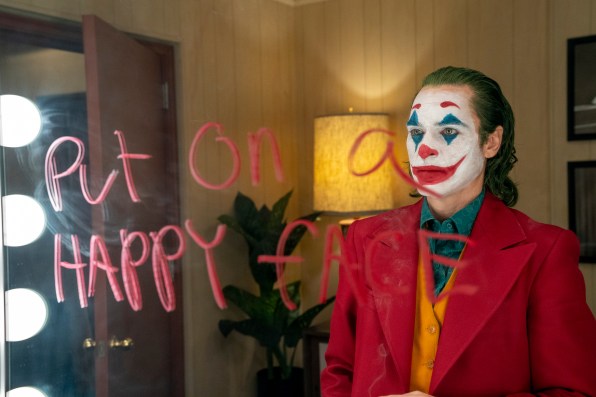
The latest victim of that same insidious cycle is the new film Joker, out in theaters Friday. At first, it sounded like, well, a joke. Just one year after Jared Leto scuzzed up the screen with his dud gangster take on Gotham’s Clown Prince of Crime, the director of The Hangover and Old Schoolannounced that
he was making a stand-alone Joker movie. Here we go again. How far
Batman’s most worthy adversary had fallen from the cinematic heights of
yore, presumably.
A few months later, though, the casting of soulful-eyed Joaquin Phoenix piqued fan interest. As did the first trailer a year later. Finally, Joker
premiered at the Venice Film Festival in late August, which is how
cineastes entered the broken house of mirrors in which we now find
ourselves.
Much like the Waller-Bridge photo, it started with
applause: an eight-minute standing ovation, followed by a Golden Lion
win, the most prestigious award at the festival. Ecstatic takes pinged
rapidly around Movie Twitter, echoed by the most corrosive kind of fans in the world.
Since
every action inspires an equal and opposite reaction, then came the
preemptive backlash. “Just what the world needs—another story of a sad
white dude taking his hostility out on everyone else,” et cetera et
cetera. In response came a different wave of backlash, citing the film
as dangerous in its potential activation of an incel uprising. This line of criticism was then elevated in the past week, when the U.S. military issued a warning about potential violence at Joker screenings after picking up some chatter about it on the dark web. Now, undercover cops will be stationed in select screenings throughout Gotham, er, I mean New York City.
advertisement
So, depending on whom you ask, Joker is either the best movie ever, the least necessary movie ever, or irresponsible agitprop.
After attending a screening and Q&A last night, however, my opinion is that it’s none of those things.
Anyone
who thinks they’re not going to like it probably won’t—and shouldn’t
waste any time on it. For anyone else uncertain based on what various
factions of the internet claim the movie is, here are some things Joker is not. Zazie Beetz as Sophie Dumond (left) and Joaquin Phoenix (right) as Arthur Fleck in Joker. [Photo: Niko Tavernise/Warner Bros. Entertainment]
A straight-up remake of ‘The King of Comedy’
No
sooner was it revealed that this version of the Joker was a failed
comedian and Robert De Niro would play the talk show host he idolized
did the King of Comedy discourse begin. Joker was either an homage to Martin Scorsese’s 1983 film
or an outright remake. What’s clear from the actual movie, though, is
that director Todd Phillips has a lot of affection for Scorsese and De
Niro’s late ’70s/early ’80s collaborations, and decided to nod to one of
them in particular while emulating their aura altogether. Because the
Joker’s attempts at being a comedian are comic-book canon, and the new film doesn’t lean on King of Comedy quite as heavily as the trailer implies, the inspiration makes sense in context.
A sympathetic portrait of a supervillain
Pitiable
is not the same thing as sympathetic. It’s sad that Arthur Fleck was
born into the life we find him in. What he does once we meet him does
not require us to be on his side, though, nor does it particularly
demand that we do so. At least not any more than TV shows like Breaking Bad or The Sopranos ask us to relate to their antihero leads. Personally, I felt more uncomfortable being asked to consider Dick Cheney’s humanity in Vicethan I did contemplating the societal and neurological circumstances that lead to Joker’s rampage. Joaquin Phoenix as Arthur Fleck in Joker. [Photo: Niko Tavernise/Warner Bros. Entertainment]
An incel call to arms
There
is indeed some political commentary baked into the movie. This take on
the iconic character is emblematic of empathy-devoid MAGA hats.
Phoenix’s Arthur Fleck has a Tourette’s-like mental condition where he
laughs at inappropriate moments. He also has a tendency to target
elites, and his rampage threatens to inspire a populist revolution. What
could be a better metaphor for the disaffected sociopaths who memed
Trump into office, the people who celebrate his constant cruelty as
though it were all just Twitter trollage?
advertisement
However, the movie does not
seem designed to appeal specifically to the incel set. Arthur is a bit
obsessed with a woman who pays him a brief kindness, but he is never
driven by spiteful horniness. Nor does he want to kill all the chads. If
this increasingly dangerous community adopts this character as its
newest hero, it would be a stretch to argue that they’ve been courted. Joaquin Phoenix as Arthur Fleck in Joker. [Photo: Niko Tavernise/Warner Bros. Entertainment]
One long distillation of its director’s opinion
The argument around separating the art from the artist has come up a lot more in the past couple of years—and in some wildly unpleasant ways—so it’s a nice change of pace just to caution that one need not love everything Todd Phillips says in order to enjoy Joker.
“Take
away the Joker and this movie couldn’t get made,” Phillips told the
crowd at the screening I attended earlier this week. It’s a comment
about the sorry state of cinema these days, where only superhero movies
and remakes can flourish at the box office. No matter how many movies
like The Big Sick, The Favourite, and The Farewell rack
up awards and deliver a significant return-on-investment, some people
always pretend as though original ideas are verboten. They’re not. I’m
glad Phillips experimented with superhero movies by grafting one onto a
different, gritty genre and removing the franchise drive, but the idea
that this was the only way Hollywood would greenlight a violent
character study now is garbage.
Worse still, Phillips has tilted the conversation around Joker this week toward an interview
in which he claimed he’d moved away from making comedies because the
culture would no longer permit his brand of humor. “Go try to be funny
nowadays with this woke culture,” he says in the piece. “There were
articles written about why comedies don’t work anymore—I’ll tell you
why, because all the fucking funny guys are like, ‘Fuck this shit,
because I don’t want to offend you.’ It’s hard to argue with 30 million
people on Twitter. You just can’t do it, right? So you just go, ‘I’m
out.'” It should be noted that Phillips’s last three movies were The Hangover II (2011), The Hangover III (2013), and War Dogs
(2016), none of which were well received, although the first two made
tons of money. Politically correct audiences aren’t standing in the way
of anyone being funny these days, but lord knows that they’ve become a popular punching bag among middle-aged funnymen.
I’m almost convinced that Phillips’s comments were designed to be used
as stealth marketing for a film in which someone who can’t make people
laugh goes for a very different kind of reaction.
Either that, or he wanted the Joker to seem more sympathetic by turning himself into a villain.
When
you ride down this bike path in a woods in rural Belgium, the path
gradually rises in the air—and at its highest point, around 32 feet
above the ground, propels you through the canopy of pine trees. The
path, called Cycling through the Trees,
is one of a handful of breathtakingly unique experiences that the
Belgian government has created to draw people to the countryside and get
them on bikes. “With these projects, we want to increase the
interaction even more with the natural beauty of our landscapes while
cycling,” says Igor Philtjens, the regional minister of tourism and
chairman of the tourism agency Visit Limburg, who led the creation of the new path through the forest.
Throughout
the late 19th and 20th centuries, Frank Lloyd Wright’s architectural
designs came to define the American landscape, a distinction that still
holds true today. Over the course of his storied career, the architect
built everything from private homes to public pavilions; in total,
Wright designed approximately 425 structures.
advertisement
On
October 16, the Norman Lykes House, Wright’s last residential design,
will be on sale at auction. The Phoenix, Arizona, home is being sold
without reserve by Heritage Auctions and will have no minimum starting bid.
“A
late Frank Lloyd Wright house in such impeccable condition is truly a
treasure,” Nate Schar, director of Luxury Real Estate for Heritage
Auctions, said in a statement. “Bidders will have the opportunity to not
only buy this incredibly livable mid-century modern home, but also to
own the final masterpiece from the most iconic American architect.” [Photo: Heritage Auctions]The
3,095-square foot, 3-bedroom, 3-bathroom contemporary estate is located
on over 1.3 acres near the Phoenix Mountains Preserve in Palm Canyon.
The curvilinear house—one of only 14 circular dwellings designed by
Wright—blends into its mountainside location, thanks to the use of
hand-carried concrete blocks. “The Norman Lykes house was greatly
influenced by Wright’s fascination with geometry in his later years.
Curved lines in the home playoff the curves of the Phoenix Mountains,
and the cantilevered roof line provides natural shade on the south
facing façade. The windows never see direct sun, yet the house is light
and bright,” Brent Lewis, director of Design for Heritage Auctions, said
in a statement.The single-family residence, also known as the
Circular Sun House, was designed in 1959 and completed in 1967 by
architect and Wright apprentice John Rattenbury after Wright’s death.
The two-story home has only been on the market once before, and still
holds all of its original, custom-built furniture. “Hallmark design
elements of Wright can be seen in the extensive Philippine mahogany
woodworking and built-in furniture, and in the fine details like the
ventilated staircase and the show stopping circular fireplace,” Lewis
said. [Photo: Heritage Auctions]The
house also boasts a crescent-shaped swimming pool (luxuriously lined
with mother of pearl), carport, and central heating and
air-conditioning.
When the Lykes family sold the house in 1994, it
featured five bedrooms and three bathrooms. But the following buyer
commissioned Rattenbury to renovate the interior by collapsing the five
bedrooms to three larger ones. Other updates, like turning the original
workshop into a media room, were made as well, in cooperation with the
Frank Lloyd Wright Foundation.
advertisement
Not all Wright homes have received that level of attention. Buying a Wright home can be a complex, long-term project, as the Wall Street Journal
reported; as these homes pass from owner to owner, it’s inevitable that
they’ll need to be renovated and updated to withstand the passage of
time. Bidding begins on October 16, and you can follow online here.
The
reasons why people juggle the extra work vary, but the Bankrate survey
found that the average monthly income from side hustles is about $1,100.
No wonder people are eagerly taking on gigs that draw on their
strengths, interests, or available time like driving for Uber or Lyft,
party planning, coaching, offering fitness instruction, or home repair.
However,
plenty of side hustles require a measure of personal interaction that
may be making the introverted reader start to sweat. Although there’s a wide continuum
between introversion and extroversion, the emotional cost of additional
face-to-face interaction may make some side jobs more challenging than
others.
“Even extroverts need time to themselves,” says Chris Guillebeau, author of 100 Side Hustles.
But if you’re an introvert who works around people for your day job,
it’s especially important to choose something where you can do most of
the work on your own terms, Guillebeau says. “People tend to be much
more successful with their projects when they’re excited to work on
them,” he adds, “If they’re worn out at the end of the day, the last
thing an introvert wants to do is make sales calls. But if they can
spend time creating an online course or finding items for resale, it can
actually bring energy instead of drain it.”
So when Guillebeau’s
book by was delivered to our office recently, we decided to look at the
gigs best suited to those who are more introverted. Here’s what we
found:
Resource expert
The best ideas often come from the
things we use every day and get really good at. Take Sumit Bansal, a
former marketing manager at IBM in India. Bansal used Excel on the
regular and was often fielding questions from his coworkers about the
finer points of spreadsheets. He started a blog to serve as a repository
for FAQs, and before long, he was monetizing it. However, it wasn’t
until he began offering a full online course in Excel basics that the
money started rolling in. It’s been so successful, Bansal’s side gig is
now his full-time job.
While tutoring is often touted as a
potentially lucrative side hustle, it does require a person to spend
scheduled time with others. Expert courses like Bansal’s are available
for anyone to take online, so there’s no need to be present to earn the
money. Courses can be priced anywhere from $10 to over $100 depending on
the subject matter and how deeply its explored. The key is to draw from
your personal expertise and interests.
advertisement
Cleanup crew
James
Hookway, a full-time accountant from Australia, stumbled on a great
side gig after throwing a holiday party. “Hangover Helpers” aimed to do
what no one felt like tackling the morning after a big bash—clean up.
Hookway created a Facebook page and got his first booking that week. All
he had to do was show up to the trashed venue in the morning (after
everyone had left) and bring a lot of cleaning supplies and elbow
grease. Although he hasn’t quit his day job yet, the company earned
$45,000 in its first two years.
The thing about cleaning that may
appeal to introverts is that for both offices and homes, it’s a pretty
solitary job. And for those who are neatniks, nothing beats the
satisfaction of setting everything to right, all while earning a little
extra dough.
Creative on demand
Architect Gerald Lau
decided to try a print on demand business. Essentially he’d create a
t-shirt design, and when he’d get an order for one, he’d have it printed
and shipped to the buyer. The cost to set up shop was minimal: he
bought a domain name for his website and a Shopify subscription to take
and fulfill orders. He also contracted with a third-party service to
print and ship his orders.
This meant that Lau didn’t have to do
any actual selling. Most of the creative work fulfilled his passion for
creating designs, which he’d add to the website. If someone ordered,
great; if not, Lau didn’t have to worry about getting rid of overstock.
On-demand printing means that you don’t have to carry inventory and you
can experiment with different designs to see which ones resonate with
customers. Those that don’t can simply be taken down.
The caveat
is that because startup costs are so low, there’s a lot of competition.
But there’s only one you, and you should be able to mine your expertise
and imagination to create a concept that no one else will have. The
first time Lau hit revenue of over $1,000 was because he’d hit on a
unique offering for kids.
Delivery service
Of course, you
could always get a part-time job delivering pizza or UberEats orders.
But Julia Baldwin and her husband decided to take control of the entire
business. The two happened on an idea to offer to bake and deliver
cookies during the night. Their After Dark Cookies took off in Portland,
Oregon, thanks to the fact that not many places in that city are open
and up for late-night deliveries.
advertisement
It
also helps that there are plenty of college students around, but some
of their orders actually came from people out of town who wanted to send
a local a gift. Their startup costs were $3,000, but their income is
now $8,000 a month.
This could be a great side hustle for an
introvert with a passion for cooking. As the Baldwins have seen, their
interactions with customers have proved to be positive—hugs were
exchanged—but minimal. And the opportunity to be creative both with the
product and the marketing could offer the kind of intellectual
fulfillment a day job doesn’t always provide. You do have to be sure to
comply with local laws regarding food preparation and sales.
App creator
An
accountant found a clever way to make money in a side hustle by combing
the App Store. Trevor McKendrick was working part-time and accidentally
hit on a way to earn more by finding high ranking apps with poor user
reviews. He used his Spanish language expertise to land on an app for
Spanish speakers.
But he didn’t have the technical chops to create
an app himself, so he outsourced that part. The app went on to make
money and he added an audiobook version. When he got to generating
around $8,000 per month, he sold the app to a larger company. He’s now
looking for another opportunity.
It’s easy to see how someone with
a tech background could duplicate his success without the overhead of
hiring another person to take care of the development. And for those who
are looking to break into the tech market but don’t have the work
experience to land a full-time job as an established professional, this
side gig could be just the ticket. In the meantime, it’s a low-stress
hustle that requires minimal outside interaction.
Of course,
introverts can successfully build side hustles that do require working
with people. You just need to be honest about how much interaction you
want to have, especially after work hours. As Harvard Business School
behavioral scientist Francesca Gino told Fast Company,
just “knowing your type when it comes to personality is important
because by increasing our awareness of where we stand in terms of
introversion and extroversion, we can develop a better sense of our
tendencies, manage our weak spots, and play to our strengths.” And
knowing your strengths will also help you find the best side hustle for
you.
advertisement
One
thing to keep in mind, regardless of your personality type, is to know
when to persist and when to call it quits. Guillebeau says if you’re
running out of steam (and money) it’s important to ask yourself if you
still believe in the overall project. “If you do, maybe you just need to
change something about it—a different market, product, or outreach
strategy, for example,” he suggests. But if it’s not working and you’re
no longer thrilled about it, you might as well move on and try something
different, he advises. “Life is short, and there’s a lot of power in
giving up,” says Guillebeau, “Besides, with most side hustles, the
stakes are low, so don’t be afraid to experiment.”
Does
your personal website look worse than MySpace circa 2007? Click over to
Humans, a crowdsourced project that showcases the web’s best personal
websites.
For
today’s creative professionals, your online portfolio is arguably now
more important than your résumé. In our era of peak personal branding,
professionals are making themselves hyper-visible through the use of
social media and slick personal website design. More and more,
networking is taking the place
of traditional credentials; as a result, people are creating platforms
for themselves that turn on the axis of connectivity and pleasing
aesthetics.
advertisement
Koby
Ofek, a Tel Aviv-based entrepreneur and former technology journalist,
noticed this trend and has created a new website that speaks to the need
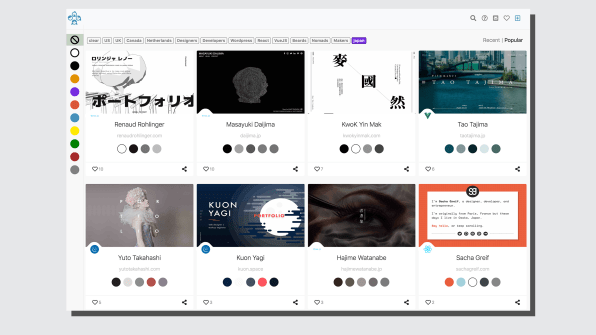
for design inspiration when building a brand. Humans
is like a carefully curated Pinterest board that offers insight into
what the best personal websites look like, which services are used to
create them, and the technology necessary to build them. “It started
with a personal journey to find inspiration to create my place on the
web. I wanted to raise my profile a bit and was thinking, ‘What would be
the best way to go about it?'” Ofek says. “It’s hard to decide what to
show and how. I wanted to see some examples of other people’s work
before I designed my own project.” [Image: courtesy Koby Ofek]When
it comes time to choose a platform to host and design a website, users
have options: WordPress, Wix, and Squarespace, just to name a few. All
of these approaches, coupled with the option to code from the ground up,
make it overwhelming for people to know which one will best suit their
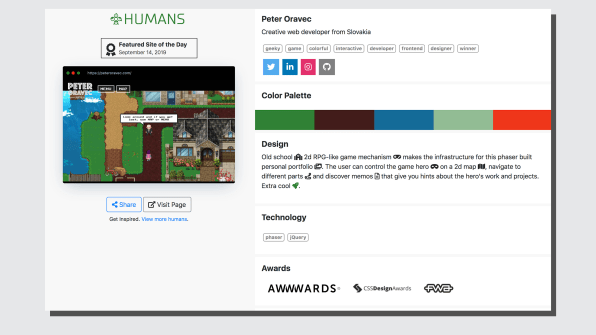
needs. For each website covered on the site, you can check out the
design, technology, platform, color palette, awards given, and
characteristics of the person who built it. You can also filter through
the featured portfolios by color, industry, location, and more.
The
websites seen on Humans were sourced from a huge swath of the web—via
Twitter accounts belonging to web designers and developers, web-design
award sites, and social-media platforms dedicated to design. His
criteria for inclusion wasn’t to only add the best-looking websites, but
to have a variety of styles, services, and technologies to see what’s
already out there. There are minimalist websites with blank backgrounds,
and flashy sites with all the design bells and whistles. “It’s up to
the community to upvote what’s interesting and bubble up the better
designs,” Ofek says. [Image: courtesy Koby Ofek]Ofek
launched Humans with 500 websites and has received roughly 1,200
submissions for inclusion since. Early on, reviews were mostly for
professionals with some role in building the web—developers, designers,
illustrators, writers, and so on. But over time, Ofek received requests
to cover many other types of “offline” professions such as activists,
hairdressers, authors, baristas, and more. Those categories are all
coming soon to Humans. In the future, Ofek hopes to incorporate
additional features to his crowdsourced inspo site. For instance, he
wants to make it possible for users to view version changes, so they can
track how a portfolio looked in the past and how it improved as web
design evolved.
Since Humans launched about a month ago, Ofek’s
been busy curating and updating it, so if you’re looking for his
personal website online, you won’t find it. He’s been so focused on his
passion project that he hasn’t had time to complete his own.
As
a designer, Virgil Abloh is fascinated with taking things out of
context, prompting his audience to rethink everyday objects. That’s
exactly what he does with his much-anticipated 15-piece collection he
designed for Ikea, which drops in stores on November 1, 2019.
advertisement
Take,
for instance, the Ikea receipt, which is instantly recognizable to
anybody who has ever set foot in the Swedish furniture store.
The
piece of paper has the brand’s logo in bold print on top, a bar code,
and frayed edges from where the paper is torn off the roll. Most of us
don’t really pay attention to the design of our receipts: We stuff them
in our wallet, in case we ever need to return something. But Abloh
transforms the humble Ikea receipt into a work of art in the form of a
low-pile 3-by-7-foot rug that costs $99. And in an even more meta twist,
the receipt lists the rug as the item purchased.
“The receipt is a
trademark in itself that has been transformed into art,” Abloh explains
in a statement. “I think that this rug can just as easily be on a floor
or hung on the wall—in both scenarios, the rug highlights the entire
story which Ikea embodies.” This
Ikea line will be called Markerad, which means “clear-cut,” “crisp,” or
“pronounced” in Swedish, hinting at Abloh’s approach to design. In
contrast to Abloh’s luxury streetwear brand Off-White, the Ikea
partnership will be an opportunity for fans to get their hands on
products designed by Abloh at an affordable price point.
Many are
emblazoned with Abloh’s instantly recognizable graphic application of
all-caps type with quotation marks: There’s a shopping bag that comes in
two sizes ($19.99 for the medium and $24.99 for the large) emblazoned
with the words “SCULPTURE” on it, a $249 dark green rug that sports the
words “WET GRASS” and happens to look an awful lot like wet grass. The
quotes are designed to challenge the meaning of those words. “There’s
always an underlying message in my creations,” Abloh says in the item
description of the green rug. “A little bit of irony—and a human
connection.” [Photo: Ikea]Other
items in the collection offer Abloh’s take on conventional, everyday
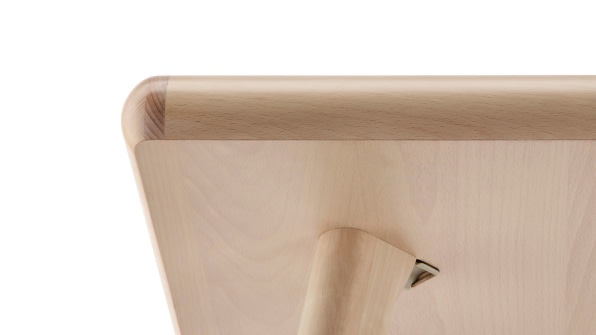
furniture items. There’s a simple $399 table and $149 chair made of
light beech wood. There’s a $199 glass door cabinet and a $199 day bed
with a $130 cover. All of these pieces are inspired by 1950s
Scandinavian modernism and are designed to be simple to assemble. For
instance, you can click the legs into the table in just one step using a
wedge-dowel fitting, without needing to use any tools. (This will come
as a relief to people like me who find complex assembly of Ikea products
terrifying.)
advertisement
This
partnership with Abloh was designed specifically with millennial
homeowners in mind, according to the official Ikea announcement. Abloh
is, after all, one of the best known designers among this particular
generation. Last year, he was named the artistic director of Louis
Vuitton’s menswear line, while continuing to collaborate with many other
brands through his Off-White label.
In keeping with Abloh’s
genius for drumming up hype, he’s been teasing this collaboration for
months. In late April of 2018, he gave fans a sneak peek of the new line
by live-streaming product prototypes on social media from an
undisclosed location in New York. In May 2019, Ikea dropped one
limited-edition item from the line, a $499 rug that looked like a
Persian carpet, except that it had the words “Keep Off” on it. [Photo: Ikea]Ikea
clearly expects droves of Abloh fans to show up to purchase these
limited-edition products: The company says that stores will begin
selling these items at 10 a.m. on November 1 in each store’s respective
time zone, and it will allow customers to line up in front of the store
beginning at 7 a.m. (camping or overnight parking, it notes, will not be
permitted).
If lining up for three hours to get your hands on
affordably priced Abloh-designed products seems like a long time,
consider the statement that Abloh makes with a round white $49.99 clock
he made for the collection. It features the word “TEMPORARY” on the
glass, casting a shadow on the clock that moves around depending on
where sunlight appears on it. Those waiting in line can ponder the
fleeting nature of time before they get their hands on the clock of
their dreams.














No comments:
Post a Comment