THAT THERE MAY BE A FAIRER SOCIETY IN GHANA - ONE IN WHICH ALL THE PEOPLE, NOT JUST A POWERFUL AND GREEDY FEW, BENEFIT FROM THE NATION'S WEALTH!
Friday, 4 October 2019
The Conversation/Christina Hicks, Andrew Thorne-Lyman, and Philippa Cohen : The solution to hidden hunger in many developing countries lies just offshore
Adjunct Associate Research Fellow at ARC Centre of Excellence for Coral Reef Studies, James Cook University
Disclosure statement
Christina Hicks receives funding from the European Research Council, BNP Paribas, and Foundation de France.
Andrew Thorne-Lyman receives funding from the USAID
Feed the Future Nutrition Innovation Lab and the Bill & Melinda
Gates Foundation.
Philippa Cohen receives funding from CGIAR, Oak
Foundation, ACIAR and through the FAO. She works for WorldFish and is
affiliated with the ARC Centre of Excellence for Coral Reef Studies,
James Cook University.
Partners
Lancaster University provides funding as a founding partner of The Conversation UK.
Globally, about two billion people suffer from “hidden hunger”
– a chronic deficiency of vitamins and minerals. The health effects of
this form of malnutrition can be severe, especially for children. They
include increased risk of poor cognitive development, impaired growth
and early death. Ironically, our latest research found that many coastal
countries where hidden hunger is rife, have plenty of nutritious fish just off their coast. Yet these fish are not reaching those who need them the most.
Fish are a source of protein and omega-3 fatty acids and are rich in calcium, iron, zinc, vitamin A and vitamin B12.
Fish also increase the “bioavailability” – that is, increase absorption
– of nutrients provided through other foods eaten in the same meal.
Humans eat more than 2,000 species of fish, but the nutritional value of these species varies greatly.
Until recently, we didn’t know enough about this variability to advise
fisheries and policymakers to help them address malnutrition.
Now a new statistical model, built using the best data on nutrient qualities of fish, has enabled us to fill in the gaps in our knowledge.
Using this model, we can accurately estimate the nutritional
composition of all marine fish based on such characteristics as the
water temperature they live in, their body size and what they eat. The
model revealed that smaller species of fish often have higher
concentrations of calcium and iron, species from cold water regions or
that feed in deeper waters are likely to have higher concentrations of
omega-3 fatty acids, and species from tropical waters tend to be richer
in calcium, iron and zinc.
Diverted or lost
Nearly half the world’s coastal countries have moderate to severe deficiency in at least one key nutrient. Yet in the coastal waters of these same countries, nutrient-rich fish are caught every day.
By looking at many years of data on fish catches,
we were able to understand just how important fish could be for
tackling nutrient deficiencies. We found that often fish catches hold nutritional potential
that exceeds the dietary requirements of certain nutrients for entire
coastal populations of children under five years old – a particularly
vulnerable age group. This was a strong trend for countries on the west
coast of Africa.
If just a fraction of the fish caught in these waters were kept for
consumption locally, it could address some of the most pressing
malnutrition problems in these countries. So why isn’t this happening?
The problem is that on these same coasts, fish are caught by illegal or foreign fishing fleets and exported as animal feed
– or are lost due to damage or rotting as fish are moved from the point
of capture to the plate. Global estimates for this waste and loss are 39%.
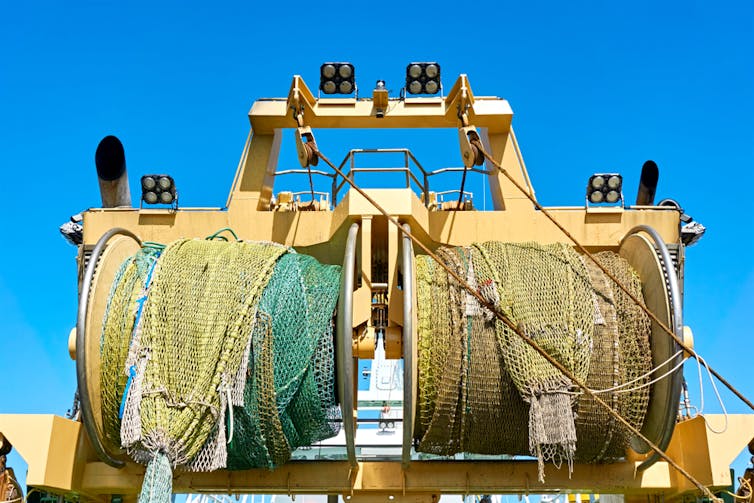
A lot of fish are caught illegally by foreign fleets and sold as animal feed.Harry Wedzinga/Shutterstock
But getting more fish to nearby populations to address nutritional
deficiencies won’t be easy. The answer probably lies in a combination of
strategies, including reevaluating trade deals that currently lead fish
away from the countries that need them most, ensuring that fish are
distributed to reach the most vulnerable people (women and children),
and working with local fish traders to reduce waste and loss. But now
that we have the evidence of which fish are most nutritious, at least
the process can begin.