Associate Professor, School of Environment, Tsinghua University
Disclosure statement
Kathryn G Logan received funding from the Natural
Environment Research Council through the UK Energy Research Centre's
ADVENT project. Funding was also received from the School of Biological
Sciences, University of Aberdeen, the Santander Mobility Award and the
Energy Technology Partnership Postgraduate and Early Career Researcher
Grant. Shi Chen has received funding from the National Key
R&D Program (2016YFC0208901), the National Natural Science
Foundation of China (No. 71690244 and 71722003) and Volvo Group in a
research project of the Research Center for Green Economy and
Sustainable Development, Tsinghua University, and a grant from the
Harvard Global Institute to the Harvard-China Project titled “China
2030/2050: Energy and Environmental Challenges for the Future”.
Xi Lu is a tenured associate professor at Tsinghua
University. He received the National Science Fund for Excellent Young
Scholars in 2017.
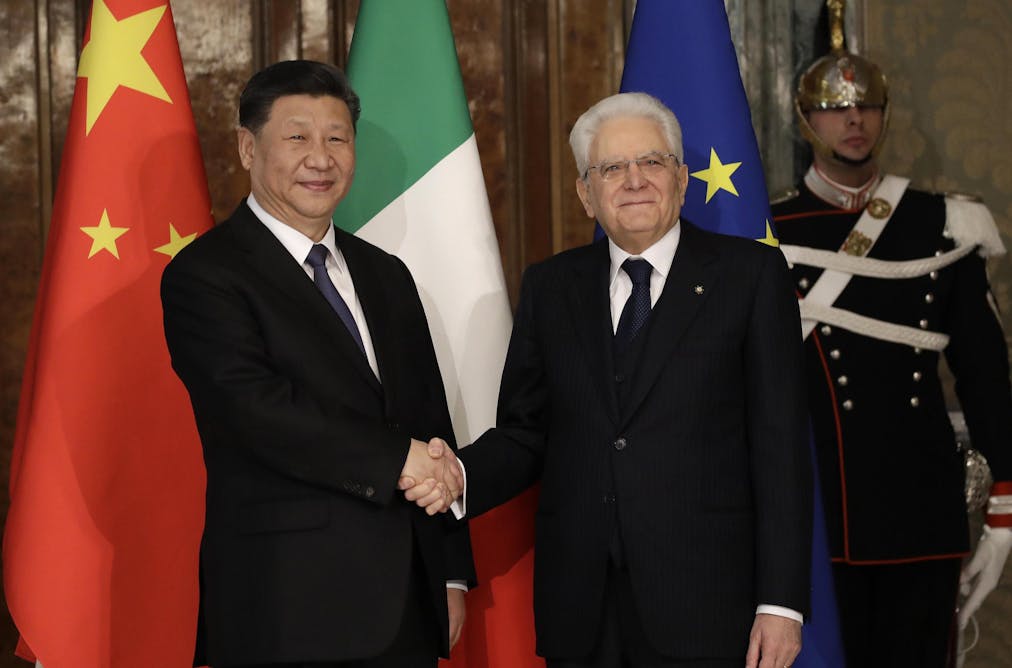
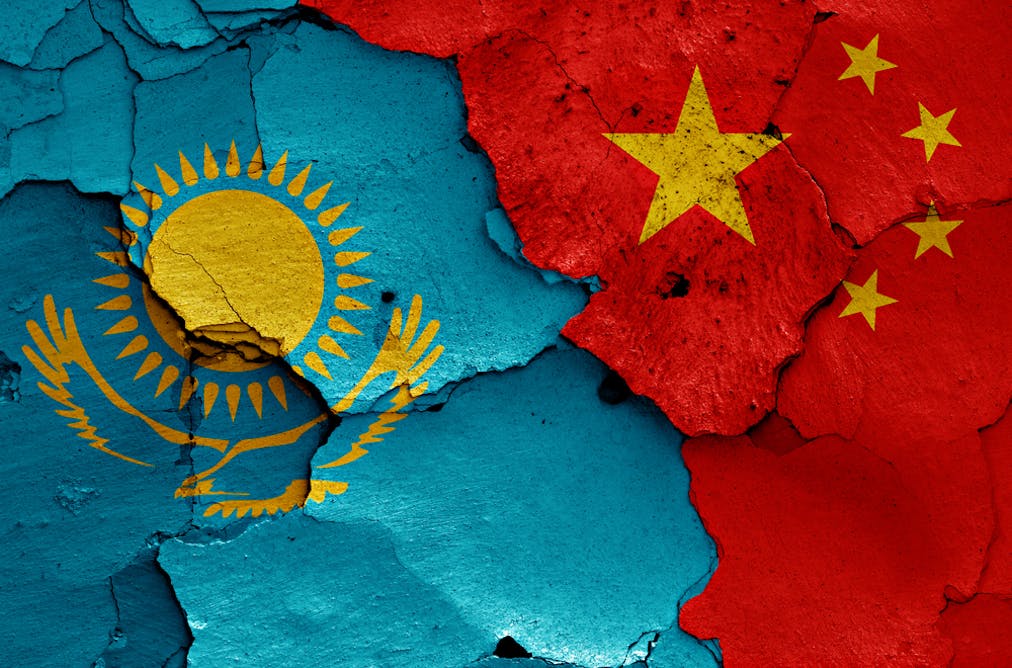
China has invested US$90 billion in the countries involved in its Belt and Road Initiative (BRI) since 2013. The BRI involves developing infrastructure in 126 partner countries
to boost trade within a region stretching from Indonesia to Western
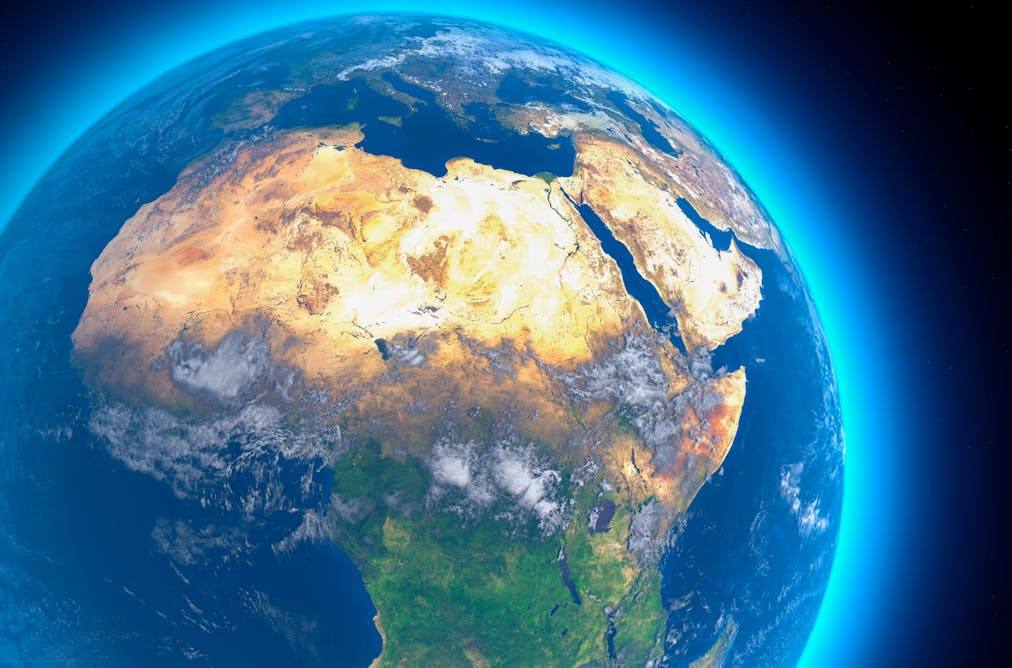
Europe via the Middle East and East Africa, inspired by the historical Silk Road.
While this economic development could help raise living standards in
participating countries, it could also come with a huge potential
increase in greenhouse gas (GHG) emissions. But our research
demonstrates the region has huge potential for generating solar power.
This could decouple economic growth from increasing carbon emissions.
Currently, over 55% of global GHG emissions come from the entire BRI region, and this number is expected to rise to above 65% by 2030
if their growth rates of emissions remain at current levels. Four
countries in particular – China, India, Iran and Saudi Arabia – are
among the top ten CO₂ emitters in the world
and were responsible for 39.4% of the global emissions in 2017. Those
emissions are likely to rise unless substantial efforts are made.
Yet the region also has huge potential to reduce emissions and become
a major source of solar energy. Little research has been done
specifically on the BRI region. So we evaluated the potential for solar
electricity across 66 adjoining countries within the main BRI region,
considering all the factors that might impact output.
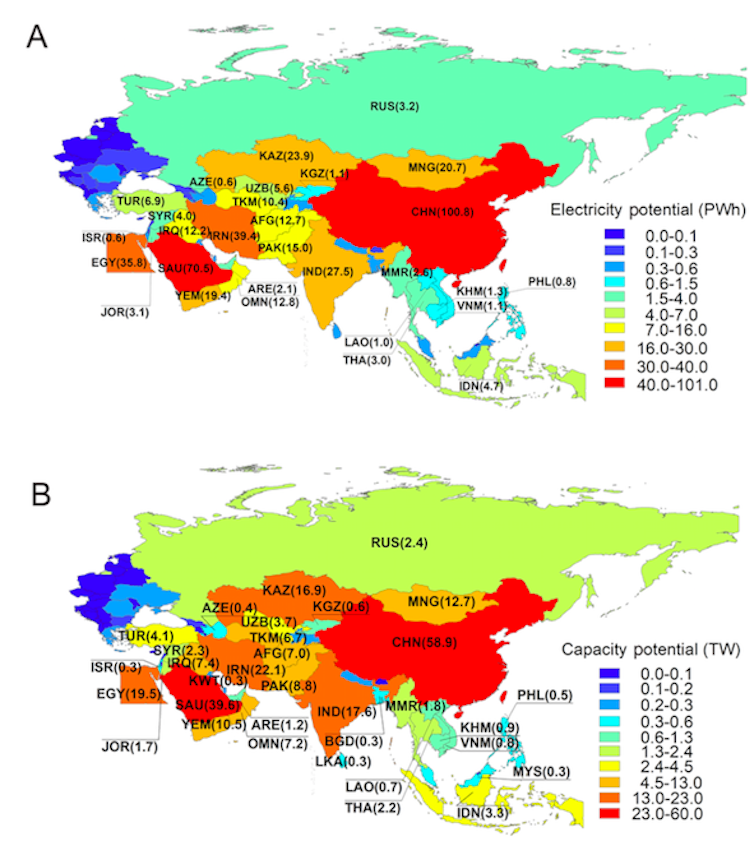
Our study suggests solar generation in the BRI region could provide a
total of 448.9 petawatt hours of electricity annually, which is the
equivalent of 41.3 times the area’s total 2016 electricity demand. Just
3.7% of this would provide enough annual electricity to power the entire
region in 2030 based on projected demand, requiring land equivalent to
approximately 0.9% of China’s total area. The BRI Countries (Chen & Lu et al,. 2019)
The four top emitters have an estimated solar potential of up to
238.2 petawatt hours, representing 53.1% of the total for the BRI region
we studied. If these countries could use solar power to generate just
30% of their electricity demand, it could save approximately 2.4 billion tons of carbon dioxide, equivalent to a reduction in global carbon emissions of 7.2%.
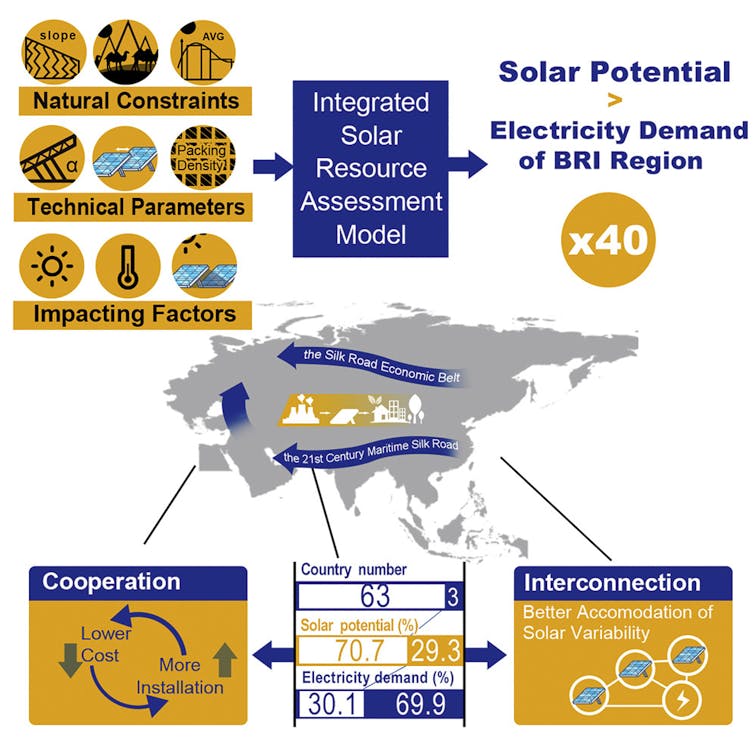
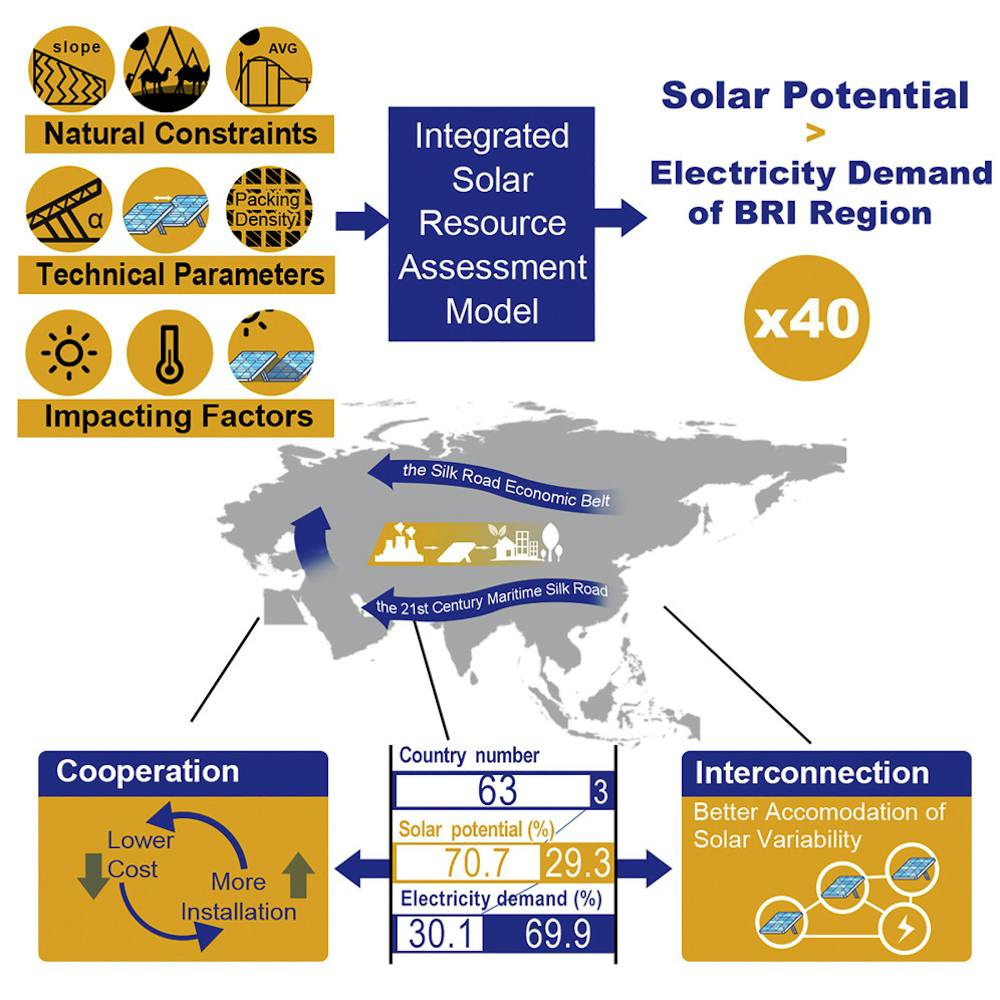
We also found that 63 out of the 66 countries consume a total of just
30.1% of the region’s electricity, but together could produce as much
as 70.7% of its solar power. However, this highlights one of the
challenges with any plans to make the most of solar power in the BRI
region. Countries need to cooperate over technology or even link their
electricity grids together in order to share their green power.
Building connections
For many countries in the BRI, energy interconnection can be achieved
by upgrading and expanding existing local interconnected grids within
each individual country rather than by creating new infrastructure. This
may make interconnection easier, cheaper and have less environmental
impact. For example, countries such as Kazakhstan could upgrade the
Soviet-era Central Asian Unified Power System designed to share hydro power between countries in the region.
Because solar power is intermittent, countries need to build their
solar infrastructure to supply electricity created in times and places
where the sun shines most, to when and where it is most needed. For
example, connecting rural areas to more highly populated urban areas,
which could be done across country borders to maximise the outputs. The Belt and Road Initiative (Chen & Lu et al,. 2019)
There are also barriers to introducing a massive solar generating
programme in the first place. Although solar energy has become a lot cheaper
in recent years, the cost of building, operating and maintaining large
amounts of solar infrastructure could still be prohibitive for many of
the lower income countries in the BRI region, and the industry might
need subsidies to make it happen.
The relatively poor condition of the electricity grids in many of
these countries will also make it harder to integrate a variable source
of energy such as solar power. This is due to the lack of modern
technologies within some of these countries, especially in regions with a
poor electricity network.
These challenges mean that governments and industry need to work
together effectively and cooperate across borders in order to reduce the
risks of investing heavily in solar. If they get it right, these
countries could jump from their carbon-intensive trajectories to a
low-carbon future.
It
is easier than ever for special interests to spread disinformation on
vital issues. To inform the public about what’s really going on, we help
experts drill down into the facts. We can’t do this work without your
help. Please support us – even a donation of $5 a week helps keep the
lights on and our important operation running.