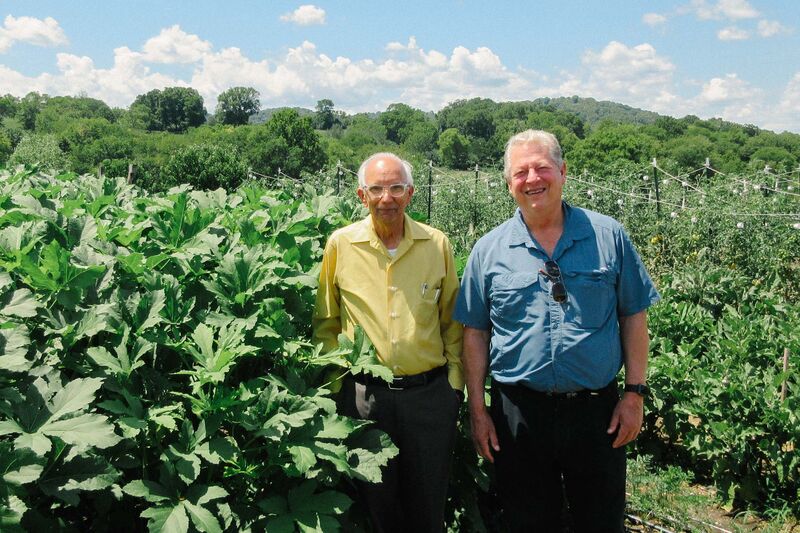
Climate scientist Rattan Lal with former U.S. Vice President Al Gore on his farm in Carthage, Tennessee.Source: Courtesy Gabrielle Hathaway
Al Gore’s 400-acre farm is located in Carthage, a small Tennessee
town where the former vice president and senator traditionally kicked
off his political campaigns. During his second act as a famous
environmentalist, the farm became the site of a training program for
aspiring climate activists, and more recently, an experiment in what
Gore said is the world’s most realistic chance at averting climate
catastrophe.
Topsoil,
the foot or so of ground underneath your feet, is responsible for
almost all food production on Earth. It also stores more than three times as much carbon as forests. Today, agriculture is a net carbon emitter, contributing about 14% of all greenhouse gas emissions, but unlike power generation or automobiles, it can be turned into a net absorber, pulling carbon out of the atmosphere.
If farming practices are changed through the use of cover
crops, low-tilling and tree-planting, Gore said, agriculture
conglomerates and family farmers alike could theoretically make their
farms more productive while fighting global warming. Those changes can
also replenish nutrients to the world’s soil, of which 33% has already been depleted.
A virtuous circle if there ever was one—and one that’s already attracting attention from farmers, consumers and food companies.
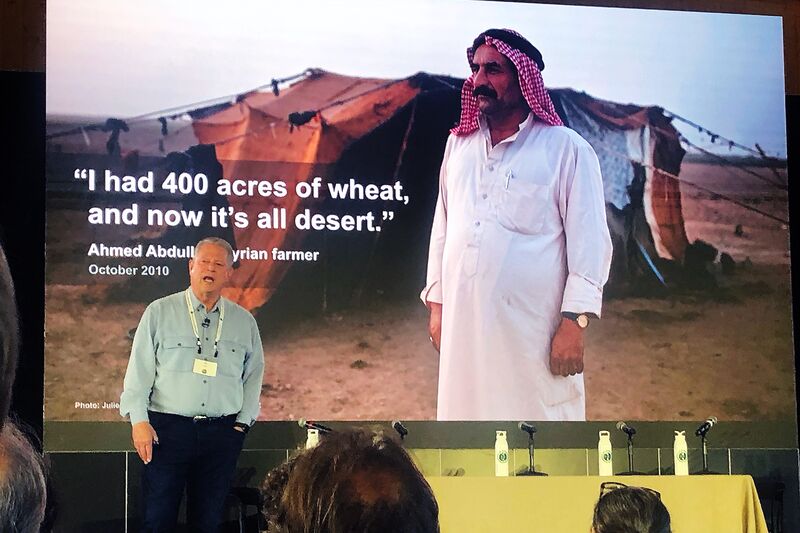
Former
U.S. Vice President Al Gore describes drought conditions that preceded
the Syrian conflict at a conference on soil science and carbon farming
on his family farm Oct. 14 in Carthage, Tennessee.
Photographer: Emily Chasan/Bloomberg
Gore,
71, is preaching the benefits of so-called carbon farming, a form of
regenerative farming, at a time when U.S. President Donald Trump has
been trying to roll back regulations meant to limit greenhouse gas
emissions. And while science-based climate policy has been a prominent
topic on the Democratic presidential campaign trail, it’s not always
seen as a priority.
Gore, who these days is more of a denim-wearing advocate than
reserved technocrat, remains undeterred. His laboratory has been the
farm where his parents once raised livestock and grew tobacco. Earlier
this month, he invited 450 soil experts—farmers, scientists, chefs, food
experts, entrepreneurs and investors—to join him there to discuss how
to scale regenerative farming into something that might actually
slow climate change.
“We’ve waited so long to start to address the
climate crisis,” Gore told those gathered. “We will need to both reduce
emissions drastically and take as much carbon out of the atmosphere as
we possibly can.”
Unlike 2006, when Gore’s film “An Inconvenient
Truth” was met with skepticism in some quarters, 13 years of
intensifying storms, catastrophic floods and unprecedented droughts and
wildfires have persuaded more Americans that there’s a very big problem.
The goal now, Gore said, is to get people to start taking carbon
farming seriously.
When it comes to actually tackling what may soon become an existential crisis, the numbers are daunting. Trillions of dollars are needed
to adapt civilization to the near-term consequences of climate change
while tens of trillions of dollars are needed to slow its advance. But
Gore said there are still too few plans to reverse global warming that
don’t rely on technology that has yet to be developed.
“Planting trees and sequestering carbon in soil are likely to
remain the two most effective approaches,” Gore said in an interview at
his Carthage farm. “There’s already some indication that farms that
operate this way are more resilient in the face of climate extremes.”
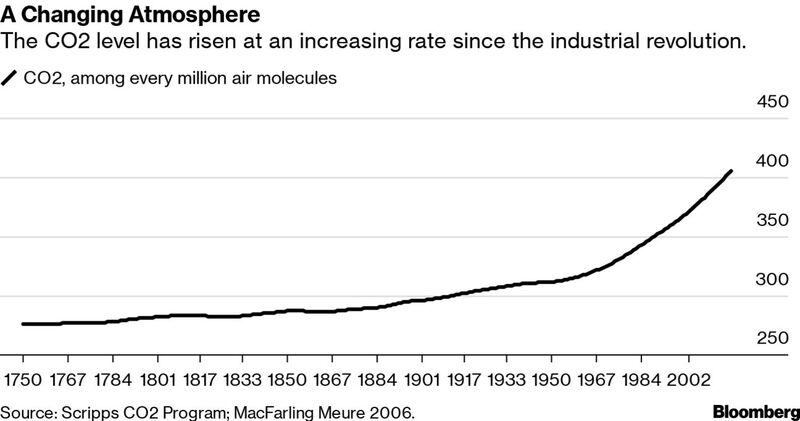
Carbon
dioxide levels in the atmosphere are at their highest in 3 million
years. Oceans, the biggest carbon sinks of all, are acidifying because
they hold too much of it. Plant life, which absorbs CO2 through
photosynthesis, can sink carbon into the soil. Regenerative farming
helps speed that along—with the added benefit of producing more
nutrient-rich soil.
Rattan Lal, a professor of soil physics and
director of Ohio State University’s Carbon Management and Sequestration
Center, is the key scientist behind Gore’s thinking. Lal served on the
Intergovernmental Panel on Climate Change (IPCC) when it shared a Nobel
Prize with Gore in 2007, and was awarded the Japan Prize this year for
his work on soil carbon sequestration.
The world’s population currently uses more than a third of the planet’s surface for agriculture, according to the United Nations. In the U.S., close to 40% of land
is farmland. Soil used for agriculture has degraded and eroded over
centuries of use, losing between 20% and 60% of its original carbon
content, according to the IPCC.
Lal’s research shows that soil can sequester carbon at rates as high as
2.6 gigatons each year. An aggressive, global combination of tree
planting and increased vegetation along with soil carbon sequestration,
he said, has the “technical potential” to absorb 157 parts per million
of CO2.
With about 415 parts per million in the air today—a huge jump compared with a few decades ago—removing even a fraction of that could slow the advance of global warming.
Gore
is realistic when it comes to the fraught politics of climate change
and the policies that would need to align to make that potential
possible. Moreover, carbon farming is a nascent concept in the U.S.:
California has a growing program and Hawaii’s plan to become carbon
neutral by 2045 includes a carbon farming framework.
U.S. Representative Alexandria Ocasio-Cortez’s “Green New Deal,”
supported in some form by several Democratic presidential candidates,
simply encourages farmers to improve soil health.
But even without any legislation on the horizon, big agriculture is starting to pay attention.
Eco-conscious
shoppers are beginning to look for food farmed with regenerative
practices, just as they do for organic products and sustainable
packaging. General Mills set a goal
in August to have 1 million acres in its supply chain transitioned to
regenerative agriculture by 2030, and a group of companies including
Danone North America and Unilever’s Ben & Jerry’s have been working
on a certification for food farmed with regenerative practices.
Not
everyone is convinced its time has come, though. Timothy Searchinger, a
research scholar at Princeton University who has studied the issue,
said scalable carbon farming is still very much a pipe dream.
“There is an unbelievable amount of scientific uncertainty,”
Searchinger said. “There is virtually no analysis that shows the
feasibility of doing any of this at scale.”
Indeed, while there is
some evidence that soil carbon can be rebuilt on degraded land, the
technique requires putting so much nitrogen in the soil that the
technique may not be viable in some places, he said. Additionally, many
regenerative farmers discover that after a few years of no-till farming,
their yields begin to fall. Searchinger said better options for
achieving natural carbon sequestration at scale would be to focus on
reducing deforestation and preserving peat lands.
“It’s not the
most useful thing to do in agriculture,” Searchinger said. While carbon
farming would be helpful, he said the bigger agricultural climate issue
is methane from livestock, something that might be addressed with feed
additives.
Representative
Alexandria Ocasio-Cortez, a Democrat from New York, speaks during a
news conference announcing Green New Deal legislation in Washington on
Feb. 7, 2019.
Photographer: Al Drago/Bloomberg
At
its most basic, carbon farming is about leaving the ground alone.
Simply plowing and tilling fields can disturb soil’s natural structure,
releasing stored carbon into the atmosphere and displacing insects and
microbes necessary for healthy soil. No-till farming creates fields that
are better at acting like a sponge to absorb both water and carbon. Gore’s home state Tennessee
leads the U.S. in no-till farming, with more than 78% of its farmland
managed that way, versus 37% for the U.S., according to the Soil Health
Institute. On his farm, some 10,000 trees have been planted to increase
soil carbon. Small groups of cattle and sheep are rotated to graze in
different areas, adding natural fertilizer to soils. The farm uses
compost and cover crops to keep the soil healthy, rather than for their
profit potential.
Regenerative farming has more costs than
traditional methods, especially upfront. Only about 108 million acres
cross the U.S. are using some regenerative practices, according to
Project Drawdown, a climate research group (as of 2012, the government
said there were 914 million acres of farmland in America). The group estimates
it would cost about $57 billion to convert another 1 billion acres by
2050, but that some 23.15 gigatons of CO2 could be sucked out of the
atmosphere by doing so.
While not a solution to the climate crisis by itself, Lal
told the audience at Gore’s farm that regenerative farming could be, at
the very least, “a bridge to the future.”
Vegetables planted on Gore’s family farm in Carthage, Tennessee.
Photographer: Emily Chasan/Bloomberg
Planting
the same cash crops each year without rotating them tends to deplete
nutrients from soil. Regenerative farming, meanwhile, results in more
nutrient dense-crops. But most farmers don’t have any incentive to
change what they are doing, because staples like wheat, rice, soybeans
and corn are usually covered by federally-subsidized U.S. crop
insurance—a $100 billion industry which currently guarantees that more
than 290 million acres of U.S. farmland deliver returns for farmers
regardless of the harvest.
“For most people, this is a very new idea,” said Will Rodger,
director of policy communications at the American Farm Bureau
Federation. “We’re certainly aware that carbon can be stored in the
soil, but farmers have very narrow margins. Many of our members are
looking very closely at it, but the question is how to make it a
business.”
The U.S. Farmers & Ranchers Alliance proposed earlier this year that lenders find more creative financing models to help farmers employ regenerative practices. A study published this month in Nature Climate Change found
that deploying land sector strategies like carbon farming, as well as
food waste reduction and increasing plant-based diets, could turn
farming into a net absorber of carbon as soon as 2050.
Gore
predicts that popular adoption of regenerative farming will someday take
hold the same way residential solar and electric vehicles have caught
on. “Farmers are doing this because they think it’s better for them,”
Gore said. “I look for signs of hope.”



No comments:
Post a Comment