Nigerians rescued from a Boko Haram camp in the north. The
terrorist group is just one element of insecurity in the region.
EPA
Banditry
is on the increase in northern Nigeria. This is a region with many
security problems, chief among them Boko Haram’s insurgency. In the
north-central region, herdsmen militancy has become a key security
concern. Northwest Nigeria, which used to be the bastion of security and
stability, has been hit hard by rural banditry.
I have explored this situation and its attendant threat in my research.
Rural banditry refers to armed violence driven principally by the
criminal intent to steal and plunder. It is motivated by the quest for
economic accumulation. The victims are individuals and communities with
material valuables. The most common examples of rural banditry in
Nigeria are armed robbery, kidnapping, cattle rustling and village
raids.
Rural banditry
in the northwestern states of Zamfara, Kaduna and Katsina has reached
alarming heights in recent years. Bandits terrorise villages with
impunity. They have actually settled in the Zamfara state, setting up
fortified enclaves in the hinterland and on the frontiers, from where
they plot and carry out their operations.
What drives rural banditry?
Crime thrives in contexts where there’s little deterrence. In most of Nigeria’s rural communities, there are many opportunities
for criminal activity. For one thing, some of these communities are
located in remote areas where there is little or no government presence.
More importantly, households are in some cases separated by and
interspersed with forest areas. This renders them vulnerable to
banditry.
This situation is made worse by the absence of effective community
policing mechanisms capable of addressing the hinterlands’ peculiar
security challenges.
In effect, the incidence and prevalence of rural banditry in
northwest Nigeria raises a fundamental question about the government’s
ability to govern effectively. The state security machinery has so far
failed to tackle the scourge of banditry. This failure stems from a lack
of political will and operational challenges.
Essentially, the prevailing socio-existential conditions in northwestern Nigeria have complicated the security situation.
The rural pastoral sector is not well regulated. Illicit artisanal
mining and the proliferation of arms in the region are also veritable
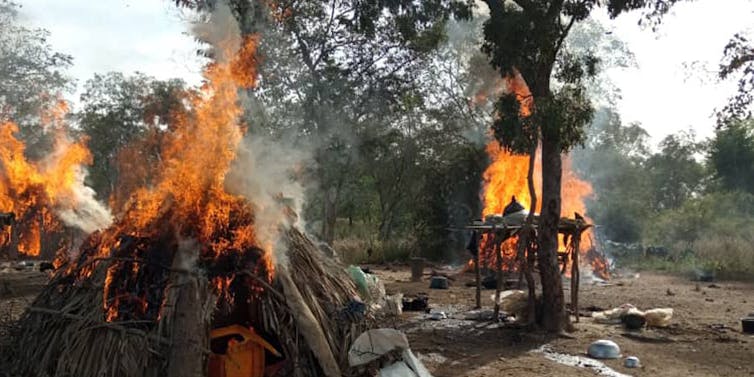
factors. A destroyed bandit camp in Zamfara.Wikimedia Commons
Geography plays a role, too. Northwestern Nigeria’s forestlands
are vast, rugged and hazardous. They are also grossly under-policed.
Some of the forests run alongside the diverse porous borderlines on the
region’s frontiers. Borders are poorly delineated, under-policed and
thus not well governed. The consequence of this is an abundance of
nefarious activity, often facilitated by criminal syndicates.
Rural banditry in northwestern Nigeria also derives impetus from the
poorly governed mining and small arms sector. Bandits have been drawn to
the region by illicit and artisanal mining in states like Zamfara where
bandits have been raiding mining sites for gold and cash.
The federal government has recognised the apparent linkage between rural banditry and illicit mining. It suspended all forms of mining in Zamfara State in early April of 2019. Transhumance
– the movement of cattle – is poorly regulated. This has seen it being
infiltrated by criminals, which has led to the intensification of cattle
rustling in the region. In states such as Kaduna, Katsina, Zamfara and
Kebbi, there exists a clan of livestock bandits who specialise in mass
cattle raids.
While some of these cattle rustling gangs are affiliated to local and
transnational syndicates, a number of them are mercenaries of Boko
Haram. Cattle rustling constitutes a valuable source of funding for the terror group.
Impacts, implications and solution
Banditry and other causes of insecurity in northern Nigeria have been
allowed to degenerate into a complex national emergency with dire
territorial implications. This mirrors exactly what happened with the
Boko Haram insurgency. From sporadic incidents, Boko Haram began
launching systematic attacks targeted at individuals, communities and,
eventually, the state.
There’s no more effective solution than forceful inland and frontier
policing. Such policing must deal with the region’s peculiar
circumstances of diverse borderlines, forestlands and hinterlands. This
requires a tactical synergy between grassroots vigilantes and the state
security operatives.
The federal government’s current counter banditry effort, based on
military reconnaissance and raids, is good and commendable. But it has
failed to bring about the needed respite, owing largely to the
operational challenges arising from insufficient knowledge of the
terrain. This makes the involvement of local vigilantes and community
watch groups, who have a better knowledge of the terrain, more
important.
However, to guard against possible excesses and abuse, people in
these structures must be properly trained, equipped and supervised. The
way forward, then, is the development of grassroots policing, enriched
by local personnel and intelligence.
The success of the Civilian Joint Task Force,
comprising local vigilantes and volunteer neighbourhood watchers, in
combating the Boko Haram insurgency in the lower Lake Chad Basin shows
the possible value of this sort of community policing.
The
Conversation aims to rebuild trust in experts and promote more informed
public debate. Our independent fact-based journalism is essential for a
healthy democracy. Your support enables us to keep our content free and
accessible.






Have your say, post a comment on this article.