The
man dubbed the ‘Sun King’ has returned to Australia to launch a
flagship solar project in Sydney and has set his sights on filling a gap
in the solar market with his new eArche module design that has achieved
astonishing reductions in weight and size.
Dr Shi Zhengrong, who
for a time was the world’s first clean energy billionaire, on Wednesday
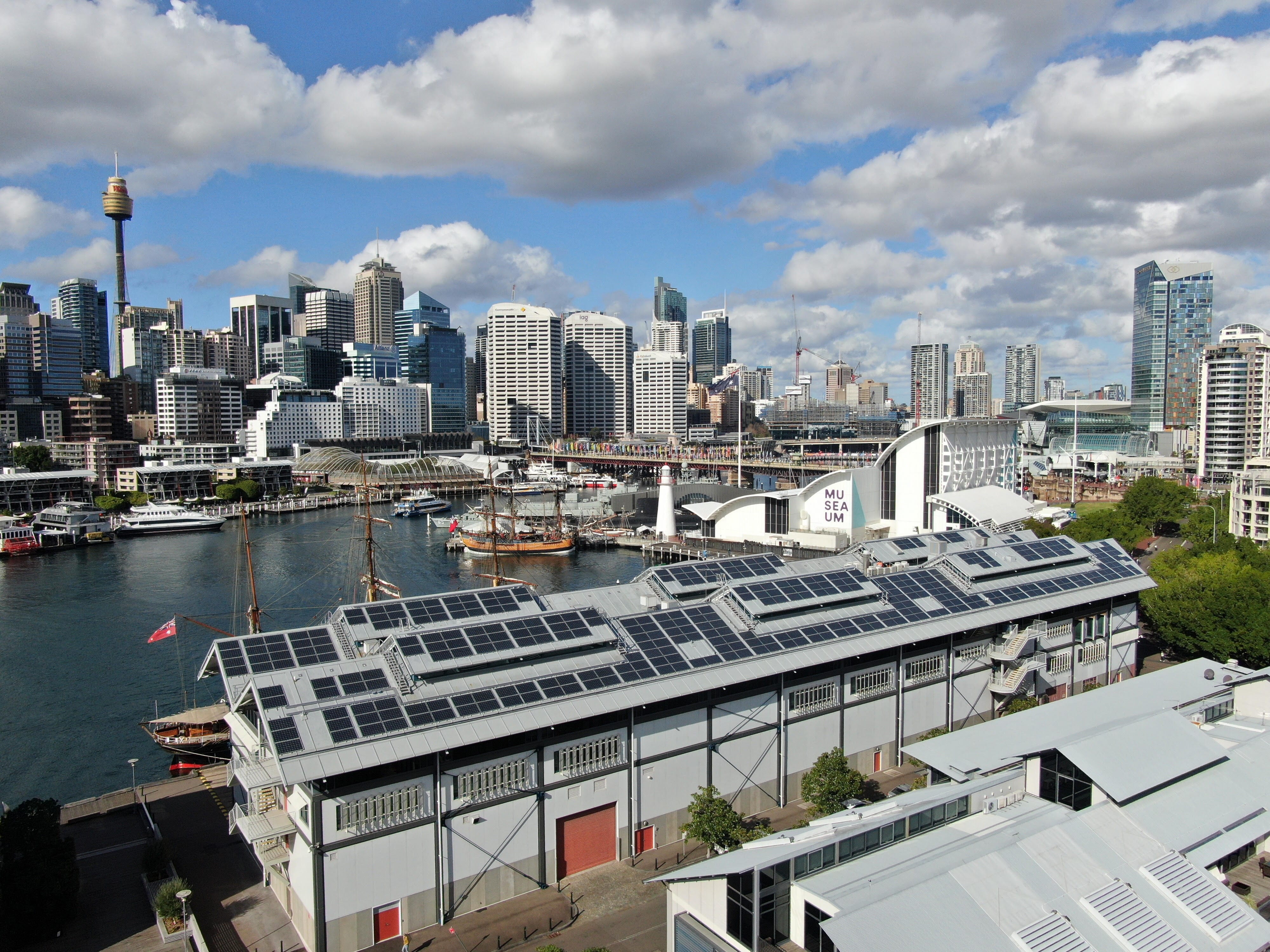
opens a 235kW solar installation at Sydney’s Maritime Museum, using
innovative light-weight solar modules that Dr Shi hopes can tap into a
massive unserved market for light-weight rooftop solar power in
Australia.
“Solar has been around for a long time, almost half a
century. In the last 20 years, the solar industry has gone from a niche
market to one of the major renewable energy industries globally, Dr Shi
said.
“We
are entering the subsidy free arena, and solar has become a cheap
source of electricity. In that context, we ask what is next?”
Dr
Shi told RenewEconomy that he sees a continuing, and growing, market
opportunity for solar power to be integrated into home design,
describing the market as being akin to a ‘furniture-style’ market where
customers are beginning to view solar power as an essential feature of
the home.
However, due to technical constraints, many homes and businesses have effectively been locked out of the market for solar power.
To address this, new products will need to be brought to the market through his new Sunman venture that will allow solar systems to be incorporated into housing products such as roofing and shade structures.
“If
you come to this ‘outdoor furniture’ kind of market, it is really
dependent on the aesthetics and design. We developed the eArche to try
and crack this new market, as it’s made with no glass and can be
integrated into almost anything,” Dr Shi told RenewEconomy.
SunMan
has developed the eArche solar module design, that avoids the need for
encasing the solar cells in glass and aluminium structures by using
composite materials, and as a result, has achieved a solar module design
that is 70 per cent lighter, and 80 per cent thinner than traditional
modules.
The combination of a thinner, lighter and more flexible
design creates the potential for the solar models to be integrated into
building materials and could be deployed onto structures with weight
limitations.
SunMan
sees the Australian market as being particularly attractive for the
low-weight solar module design, which would facilitate the installation
of rooftop solar systems onto factories and warehouses that may not be
able to support the weight of conventional solar modules.
By
expanding the potential market for distributed solar systems, SunMan
also hopes to avoid some of the issues that have impacted large-scale
solar projects.
“The large-scale solar farms are starting to face problems, from marginal loss factors and curtailment.
The distributed market makes more sense and is becoming more popular.
But if you look at commercial or industrial buildings, many of these
buildings can’t handle the weight. We see this as the low hanging
fruit.”
The Australian National Maritime Museum in Sydney will serve as the host of Sunman’s flagship project in Australia.
The
museum had been investigating the installation of solar panels on its
buildings but found that the roof structures would not be able to handle
the weight of standard panels, and combined with the 30-degree pitch of
the building’s roof, traditional modules had to be ruled out.
The
235kW installation will supply around a quarter of the power
consumption of the museum’s Wharf 7 building in Darling Harbour. The
system will utilise SunMan’s eArche solar panel design, substantially
reducing the weight of the solar installation. Credit: SunMan (supplied)“We
came across a unique glass-free solar panel from SunMan. The 5.5kg
light-weight panels could overcome the building’s structural challenges
and also have the same power output as 20kg conventional panels,” the
museum’s director Kevin Sumption said.
“When I developed eArche I
knew it could unlock the potential for solar on buildings which were
previously unable to support conventional glass solar panels,” Dr Shi
said.
“eArche innovations such as its light weight, flexibility,
high performance and competitive costs, means that solar can now be
applied to any building design.”
The eArche solar model utilises
otherwise standard monocrystalline PERC solar cells, that have been
encapsulated into a structure using composite materials, that provide
the same durability and performance as regular solar cells while
achieving a dramatic reduction in the weight of the modules.
The company launched the light weight and flexible panels in Australia in 2017, and provided a demonstration of their potential through their deployment on a ‘solar train’ project in Byron Bay.
Dr Shi
Zhengrong was among the first to achieve commercial success the early
days of the solar industry, rising to become one of the first ‘solar
billionaires’ and one of the richest people in both China and Australia.
Having
completed his doctorate at the University of New South Wales under
professor Martin Green, Dr Shi saw the opportunity to take the
innovations developed in Australia out of the lab and take them to the
market.
Dr Shi leveraged his experience at UNSW to start one of
the first highly successful solar manufacturers in Suntech, which had
grown to become the world’s biggest solar panel producer in 2011 before
the company came unstuck due to a rapid expansion, just as a substantial
supply glut hit in the international solar market.
Dr Shi now
hopes to revisit his ealier success by tapping into a currently unserved
market for solar PV and has won the backing from ARENA.
SunMan
Energy has received a $6.6 million investment from the Southern Cross
Renewable Energy Fund, which is a partnership between the Softbank China
Venture Capital and the Australian Renewable Energy Agency, with each
group tipping in $3.3 million.
“The solar technology created by
SunMan is an innovative and versatile alternative that can help to
incorporate solar into buildings making solar a key part of the building
process, and allowing solar to be installed on curved surfaces or
heritage buildings,” ARENA CEO Darren Miller said.
“The Southern
Cross Renewable Energy Fund challenges companies and entrepreneurs to
think outside the box and SunMan has achieved this.”
Michael
Mazengarb is a journalist with RenewEconomy, based in Sydney. Before
joining RenewEconomy, Michael worked in the renewable energy sector for
more than a decade.








 powered by plista



No comments:
Post a Comment